AI brand tracking helps you see when tools such as ChatGPT, Google AI Overviews, Gemini, Perplexity, and Microsoft Copilot mention your brand in answers. It can also show which competitors appear, which websites are cited, and whether an AI answer describes your business accurately.
You can start without buying software: pick customer questions, test a few AI platforms, and record results in a spreadsheet. Paid software becomes more useful when you need regular checks, many prompts, several platforms, or team reports. Track the same questions over time instead of treating one answer as a verdict.
Short Definition
AI brand tracking monitors when and how a brand appears in AI-generated answers, including brand mentions, competitor visibility, cited sources, and sentiment across selected prompts and platforms.
Practical Tech Tip
Start with 10–20 customer questions and record the platform, date, brand mentions, competitors, and cited URLs. Repeat the same checks over time; one AI answer or a visibility score is not proof of overall reach or website traffic.
Manual AI Brand Tracking vs. Dedicated Software
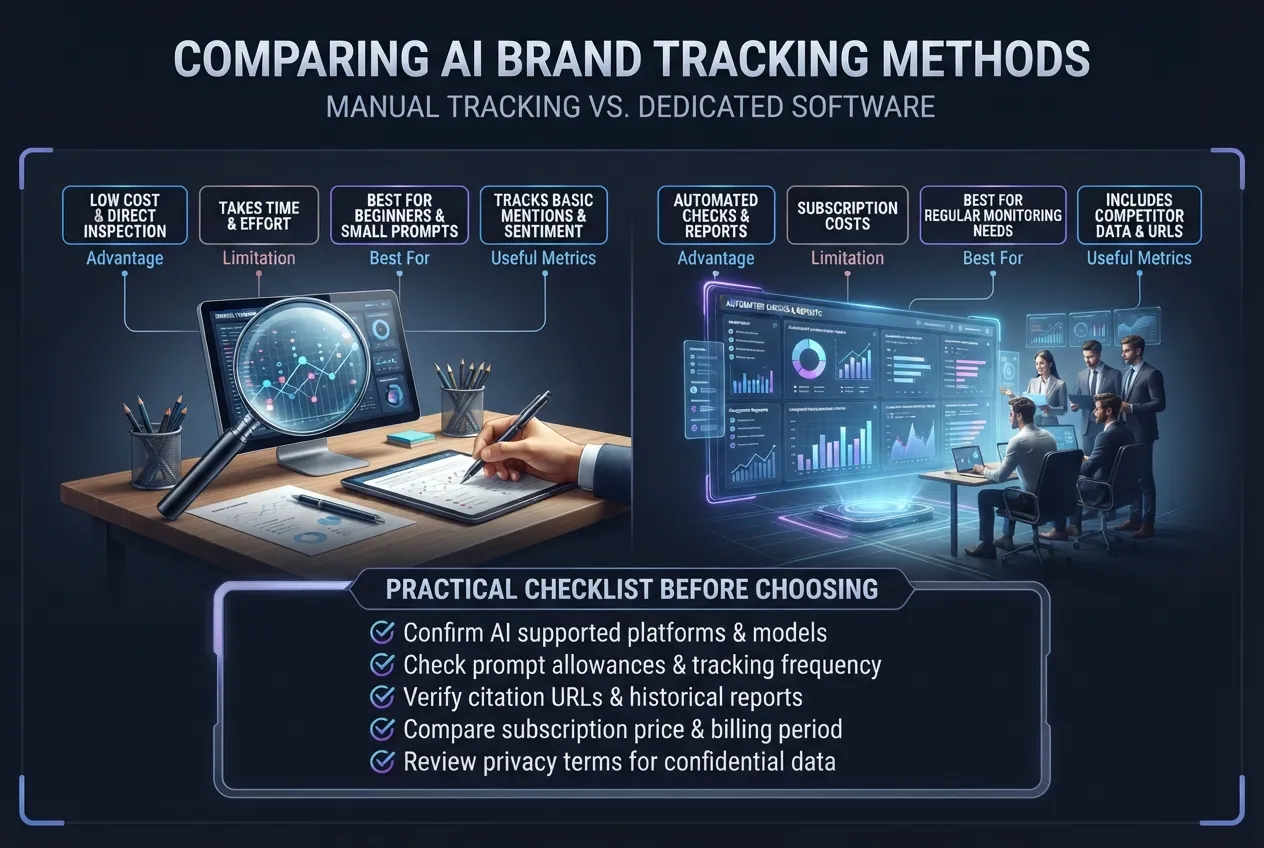
| Feature | Manual tracking | Dedicated software |
| Best for | Beginners and small prompt lists | Teams with regular monitoring needs |
| Main advantage | Low cost and direct inspection of answers | Automated checks, reports, and competitor comparisons |
| Main limitation | Takes time and requires consistent recordkeeping | Subscription costs and plan-specific limits |
| Useful metrics | Mentions, competitors, cited URLs, sentiment notes | Available metrics vary by platform and subscription |
| When to choose | When you want to understand your baseline | When automation and broader monitoring justify the cost |
Practical checklist before choosing a tool:
- Confirm the AI platforms and models it supports.
- Check prompt allowances, tracking frequency, and extra usage fees.
- Verify whether citation URLs, historical reports, and competitor comparisons are included.
- Compare the listed subscription price and billing period.
- Review privacy terms before submitting confidential business information.
What Is AI Brand Tracking?
AI brand tracking is the process of monitoring how a brand appears in responses generated by AI assistants and AI-powered search features. Instead of only asking where a page ranks in a traditional search results list, you look at what an AI system says when people ask for products, services, advice, or comparisons in your category.
For example, imagine you run a company that sells project-management software. A customer asks an AI assistant, “What is a good project management tool for a small construction team?” Your brand may be recommended, mentioned as an alternative, cited as a source, or left out. Tracking a set of similar questions helps you understand these patterns.
AI brand tracking overlaps with two terms you may see:
- Answer Engine Optimization (AEO) means making helpful information easier for answer-based systems to find, understand, and use.
- Generative Engine Optimization (GEO) is a related term for improving the chance that content is represented in generative AI answers.
Neither term promises a formula for getting mentioned. Google’s AI features guidance says useful content and sound SEO fundamentals still matter. Tracking observes outcomes; it does not automatically improve them.
What Does AI Brand Tracking Measure?
A useful tracker separates several signals. A single “visibility score” can hide important differences, so learn what each metric means before comparing reports.
Brand mentions and visibility
A brand mention is when an AI answer names your company, product, or brand. A simple mention rate is the number of checked responses that mention your brand divided by the total responses reviewed. For example, if your brand appears in 12 of 30 checked responses, your mention rate for that sample is 40%.
That is a sample result, not every AI answer users see. Prompts, platform, date, location, and repeat runs affect the percentage.
Share of Voice and competitor visibility
Share of Voice compares your brand’s presence with competitors within a defined dataset. However, tools may calculate it differently. One may count mentions; another may use a broader visibility index or modeled prompt database. Read the metric definition and make sure you compare like with like.
Competitor tracking can reveal gaps. If rivals repeatedly appear for “best accounting software for freelancers” but your brand does not, check whether your site clearly explains relevant features, use cases, pricing, and limits. A missing mention is a clue, not proof that a specific edit will make AI recommend you.
Citations, sentiment, and positioning
A citation is a linked source that an AI answer uses or displays. A brand can be named without a link, and a brand’s website can be cited without the answer recommending the brand. Track mentions and citations separately.
Sentiment describes the tone of the reference, such as positive, neutral, or negative. Positioning looks at how the answer describes the brand: who it is for, what it does well, and what limitations it mentions. Automated sentiment can miss context or mixed opinions, so review the full answer when it matters.
Do not treat mentions, citations, impressions, clicks, and sales as interchangeable. A citation can show that a page was referenced; it does not prove that a user clicked it or bought something.
How to Track Your Brand in AI Search Manually
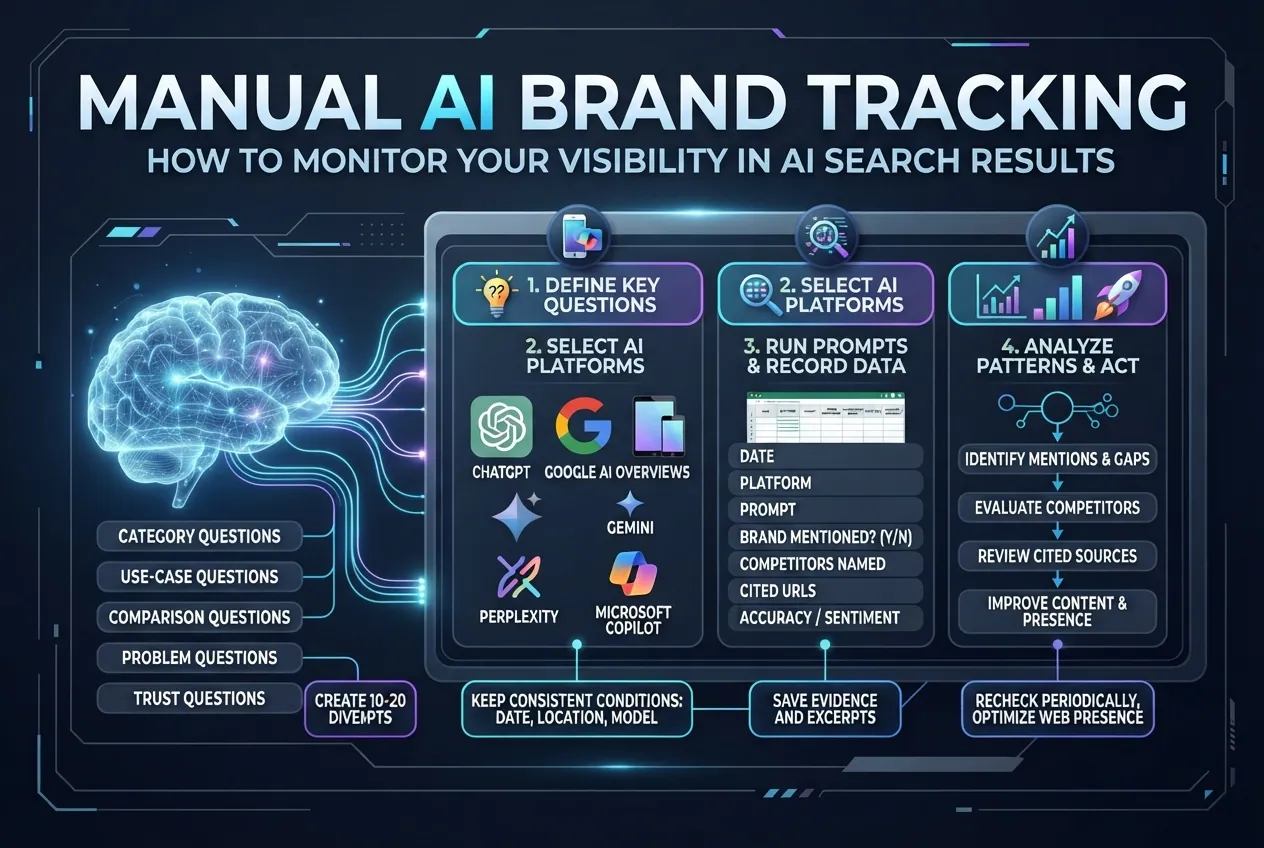
Manual tracking is a low-cost starting point for a small business, creator, or marketing team. Start with prompts that reflect how customers research and compare options.
1. Choose questions real customers might ask
Create around 10–20 prompts for an initial pilot. Treat this as a practical starting example, not an industry rule. Include different types of questions:
- Category questions: “What are the best project-management tools for a small team?”
- Use-case questions: “Which project-management app works for contractors who mainly use phones?”
- Comparison questions: “Compare Brand A with Brand B for a team of ten.”
- Problem questions: “How can a small business track client work and invoices in one place?”
- Trust questions: “What should I check before buying Brand A?”
Include neutral prompts that do not name your company; branded prompts alone will not show whether AI introduces it independently.
2. Select your platforms and keep the conditions consistent
Choose the AI platforms that matter to your audience, such as ChatGPT, Google AI Overviews or AI Mode, Gemini, Perplexity, and Microsoft Copilot. Availability and features can differ by account, region, product edition, and time.
Record the platform, date, model or mode, location setting, and whether web search is enabled. Keep conditions consistent; note any change that makes results less comparable.
3. Repeat the prompts and save the evidence
Run your prompts and repeat important ones later. AI answers can change even when wording stays the same, so do not make a major strategy change because of one missing mention.
Create a spreadsheet with columns like these:
| Date | Platform and mode | Prompt | Run | Brand mentioned? | Competitors named | Cited URLs | Accuracy or sentiment notes |
Copy cited URLs and save relevant excerpts, following the platform’s terms and your data rules. Keep customer details and confidential information out of prompts.
4. Look for patterns before taking action
After several rounds, ask which prompts produce mentions, which competitors appear in your absence, and which sources get cited. Check whether AI repeats an old price or an unsupported feature.
Investigate one or two gaps. Check that your site is current, key pages can be found, and credible sources describe your business accurately. Recheck the prompts later, but timing alone cannot prove your changes caused a new result.
AI Brand Tracking Tools Compared
Dedicated tools can automate prompt runs and organize results. They differ in the number of prompts, supported AI systems, update frequency, data sources, reports, and extra charges. The following prices are listed in US dollars on vendors’ public pages accessed on October 20, 2026. Prices and packages can change, and the examples are not a full market survey.
| Tool | Listed price and example limits | May suit |
| OtterlyAI | Lite: $29 per month for 15 search prompts, daily tracking, and four listed engines: ChatGPT, Google AI Overviews, Perplexity, and Microsoft Copilot. Gemini, Google AI Mode, and Claude are listed as add-ons. | Solo marketers or small teams starting with a short prompt list. |
| Semrush AI Visibility | Base: $99 per month per domain, billed annually; 25 custom prompts, AI visibility reports, competitor analysis, and prompt research. | Teams that want AI visibility data alongside a broader SEO workflow. |
| Ahrefs Brand Radar | Custom prompt tracking packages start at $50 per month for 2,500 checks. The AI Visibility Index starts at $199 per month for one index; all-platform access is listed separately at $699 per month. | Teams that need either their own prompts or broader visibility research across a large prompt database. |
These prices are not directly equivalent. A prompt is a question you monitor; a check may mean running one prompt on one AI platform in one location. One prompt on three platforms can use three checks per run, depending on the vendor’s rules.
OtterlyAI’s Lite allowance is small, so confirm its platforms cover your audience. Semrush’s Base plan uses annual billing, unlike some month-to-month options. Ahrefs separates custom prompt checks from its broader AI Visibility Index; each serves a different research need.
For enterprise brand research, Kantar AI Signals describes broader measurement of brand visibility, sentiment, and positioning across AI search. It does not publish a fixed public list price on the cited page, so treat it as an enquiry-based option rather than a low-cost subscription comparison.
Before paying, confirm supported models, refresh frequency, custom prompts, exports, and overage costs.
Free AI Brand Tracking vs. Paid Software
Free tools can help when you own the website, but they measure different things from a paid tracker. Combine them when their strengths complement each other.
Google Search Console has a Generative AI performance report for Search. Google says it reports impressions for AI Overviews and AI Mode, with views by page, country, device, and date. A site may not show a report if it has too little eligible activity. This is useful for understanding how your own pages appear in Google’s AI-powered search features, but it does not track every mention of your brand across ChatGPT, Claude, or Perplexity.
Bing Webmaster Tools AI Performance reports how eligible site content is cited in Microsoft Copilot, AI-generated summaries in Bing, and selected partner experiences. Its official documentation includes citation trends, cited pages, and grouped “grounding queries.” These phrases summarize the contexts in which content appears; they are not a log of every exact user prompt or AI response. Bing also warns that citations are not clicks, traffic, rankings, or a quality score.
Manual tracking suits a small prompt list you can review yourself. Paid software becomes more practical for frequent checks, multiple markets, historical comparisons, automated reports, or team access. Use native reports for your site and paid monitoring for broader competitor research.
How to Choose the Right AI Brand Tracking Tool
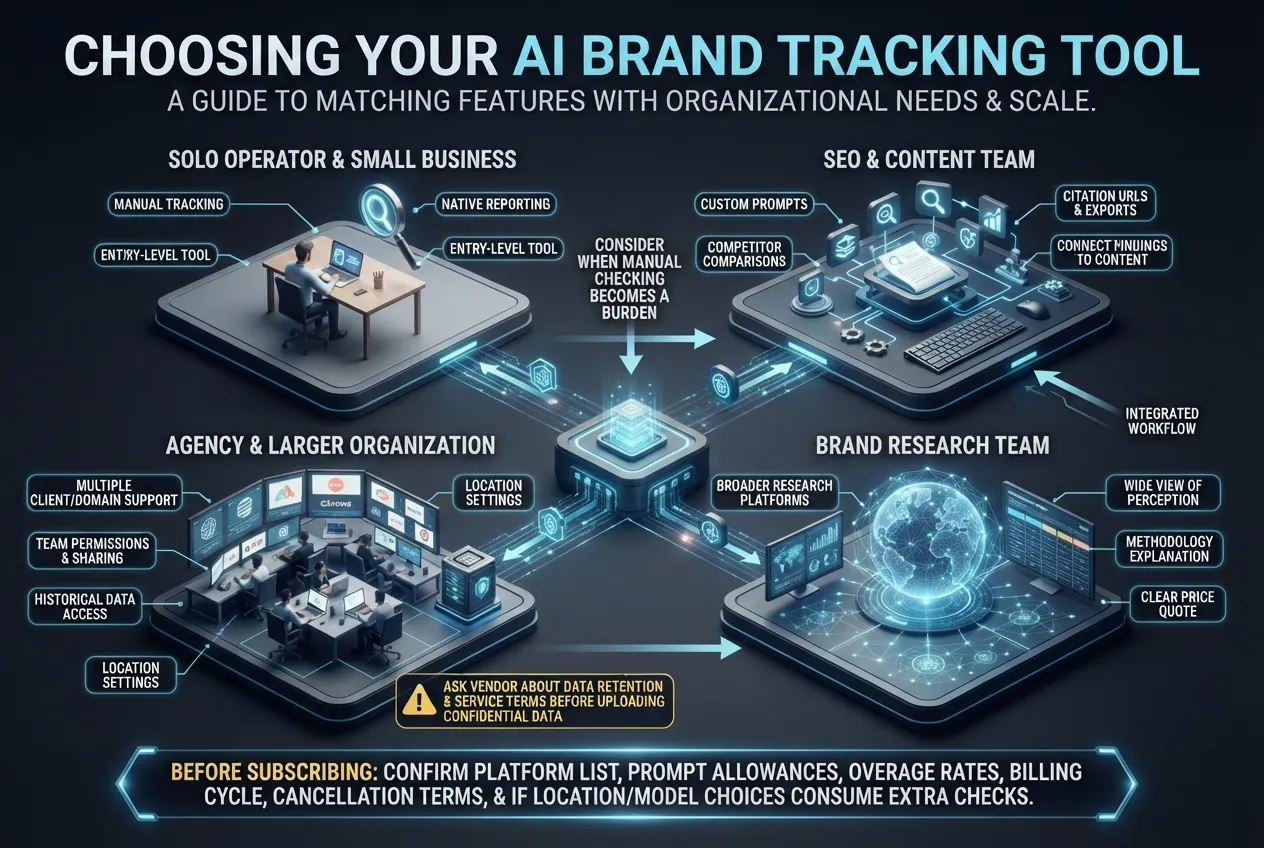
Choose based on your decision, not the longest feature list.
- Solo operator or small business: Start with manual tracking and native reporting. Consider an entry-level tool only when checking answers manually becomes a regular burden.
- SEO or content team: Look for custom prompts, competitor comparisons, citation URLs, exports, and a way to connect findings to content work.
- Agency or larger organization: Check multiple client or domain support, team permissions, historical data, location settings, and report sharing. Ask the vendor about data retention and service terms before uploading confidential material.
- Brand research team: If you need a wide view of category perception rather than just monitoring your own chosen questions, compare broader research platforms and ask for a methodology explanation and a clear price quote.
Before subscribing, confirm the platform list in the actual plan. A vendor may mention several AI products on its website while limiting some of them to add-ons or higher tiers. Check prompt allowances, overage rates, billing cycle, cancellation terms, and whether location or model choices consume extra checks.
How Accurate Is AI Brand Visibility Tracking?
AI brand visibility is measurable, but not perfectly fixed. An answer may change with the model, search results, prompt wording, user location, account state, or date. Third-party studies offer evidence that this variation matters, though their findings should not be treated as universal performance rates.
For example, Aiso reported in May 2026 (updated in July) that it ran 19 consumer prompts through ChatGPT ten times under the same US location and web-search-enabled conditions. Two runs shared an average of 55% of recommended brands. This small vendor-produced study is not a universal rate; see its methodology.
An AirOps report examined more than 45,000 citations across 800 queries and also reported frequent changes across runs. AirOps is a vendor, so treat its figures as attributed research, not a universal benchmark.
To improve your own measurement:
- Keep the prompt wording and platform settings stable where possible.
- Repeat important questions and compare results over a defined period.
- Track mentions and citations separately.
- Inspect the full answer and cited page for context.
- Compare the trend with website analytics, referral traffic, and conversions where available.
A tracker’s score is an indicator based on its method and sample. It is not the number of people who saw a recommendation, and it does not establish that AI visibility caused a sale.
What to Do When AI Gets Your Brand Wrong
Save the answer and inspect its citations. Identify the error—such as an old price, incorrect feature, or confusion with another company. Not every error comes from your website.
Next, check your own public pages. Update incorrect facts, clarify product names and intended use, maintain current help and pricing information, and make important details easy to find. If a third-party source has outdated information, contact its publisher through the normal correction process where appropriate.
Use Search Console and Bing Webmaster Tools to check whether relevant pages are eligible for indexing and whether their reporting shows activity. For content improvements, follow Google’s guidance on AI search features: focus on useful information and sound technical SEO rather than trying to discover a guaranteed AI-ranking trick.
Finally, rerun the same prompt set later. A change in answers can reflect model updates, source changes, or ordinary variation—not only your content edits. Look for a pattern before deciding whether an action helped.
Privacy and Responsible Tracking
Use public, non-sensitive prompts. Do not submit customer records, confidential plans, passwords, API keys, or private documents unless you have authorization and have checked the service terms.
Before connecting accounts, review data retention, report access, and whether submissions may be used to improve services or train models. Limit team permissions and only share approved information.
Frequently Asked Questions
What is AI brand tracking?
AI brand tracking monitors when and how a brand appears in AI-generated answers. It can measure mentions, cited sources, competitor presence, sentiment, and changes across a defined set of prompts and platforms.
What is the best AI brand tracking software?
There is no single best option for every team. Compare the platforms supported, number of prompts and checks, update schedule, citation details, history, reporting features, and total subscription cost. A small operation may be fine with manual tracking; a larger team may need automation.
Can I track my brand in ChatGPT for free?
Yes. You can enter a set of relevant questions manually, save answers and citations, and repeat the checks over time. This costs no additional tracking subscription, but it takes effort and results can vary. Native reporting tools generally cover only their own supported services.
How accurate is AI brand visibility tracking?
It can reveal useful patterns, but it is not a complete record of every user’s AI experience. Accuracy depends on the tool’s data sources, sampling method, prompts, platforms, and reporting limits. Repeat important checks and treat scores as indicators, not exact audience counts.
Is AI brand tracking different from traditional SEO?
Yes, although they overlap. Traditional SEO often measures search rankings, clicks, and website traffic. AI brand tracking looks at brand mentions and citations in generated answers, while native reports may show impressions or citations in specific AI search experiences. Neither replaces the need to understand actual site visits and business outcomes.
Start With a Simple Tracking Plan
Choose a small set of customer questions, test them consistently, and record mentions, competitors, and cited sources. Use free platform reporting for the information it actually measures. Pay for AI brand tracking software when its extra coverage, regular checks, or reporting saves meaningful work or answers a question your current approach cannot resolve. Above all, measure patterns over time and verify the evidence before changing your strategy.
Disclaimer
Prices, prompt limits, AI-platform coverage, and reporting features can change and may vary by plan or region. Check current vendor terms and confirm that a tool fits your goals before subscribing. For confidential data or account-access issues, follow appropriate security and recovery procedures.