No, AI is not always right. Artificial intelligence can provide helpful explanations, answer questions, summarize documents, and support research. However, it can also make mistakes, invent facts, misinterpret information, or present outdated details as if they were current.
The tricky part is that a wrong AI answer can sound just as convincing as a correct one. A chatbot might give a clear explanation, include specific numbers, and even provide citations without getting the facts right.
The good news is that you do not need to be a technology expert to use AI more safely. You need to understand why mistakes happen, recognize warning signs, and know how to check important information before relying on it.
Short Definition
AI is not always right. It can produce false facts, outdated information, or citations that do not support its claims. Verify important answers against reliable original sources, especially for health, legal, and financial decisions.
Practical Tech Tip
When an AI answer includes a statistic, quotation, or link, open the original source and check that it actually supports the claim. For important decisions, compare the information with a second independent, reputable source. A confident tone is not proof.
AI Answer Verification Checklist
Before relying on an AI-generated answer, check these five things:
- Identify the exact claim that needs verification.
- Open the cited source and confirm that it exists.
- Check whether the source actually supports the claim.
- Compare important facts with another independent, reputable source.
- Verify dates, numbers, context, and relevant limitations.
Decision guide: Use AI for brainstorming, explanations, and research starting points. Verify factual claims before sharing them, acting on technical instructions, or making important decisions.
Why Does AI Sometimes Give Wrong Answers?
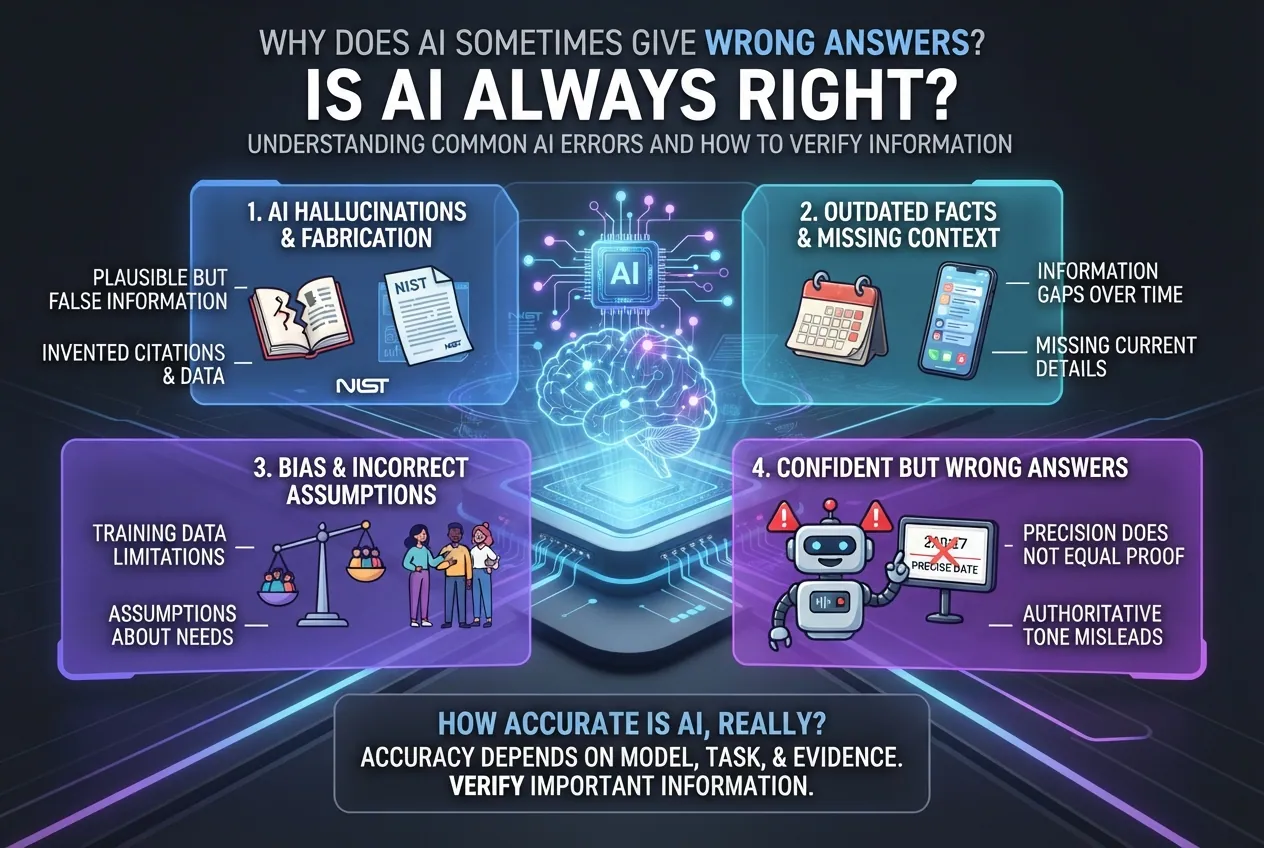
AI tools generate responses using patterns learned from training data and, in some cases, information retrieved from external sources. They do not automatically verify every statement against reliable evidence before presenting an answer.
Several factors can lead to incorrect or misleading responses.
1. AI Hallucinations and Made-Up Information
An AI hallucination happens when a system produces information that sounds believable but is false or unsupported.
For example, imagine asking an AI assistant to recommend three research papers about a new technology. It might give you realistic-looking paper titles, author names, publication dates, and journal details. However, one of those papers might not exist.
The answer looks professional, but its appearance does not make it reliable.
Hallucinations can include:
- Invented research papers, quotations, or references.
- Incorrect names, dates, statistics, or historical details.
- Fake website addresses or links that lead to unrelated pages.
- Incorrect explanations of how a device or software feature works.
- Conclusions that are not supported by the information provided.
The National Institute of Standards and Technology (NIST) identifies confabulation, or confidently presented false content, as a risk associated with generative AI.
This does not mean every AI response is unreliable. It means you should judge an answer by its supporting evidence rather than by how smoothly it is written.
2. Outdated Facts and Missing Information
AI can also give a wrong answer because its information is incomplete or no longer current.
Think about questions involving software updates, product prices, subscription plans, government policies, or recently released devices. These details can change quickly.
An AI model without access to current information might describe an older version of an application or give instructions for a menu that no longer exists.
Even an AI assistant with web access can make mistakes. It may retrieve an outdated page, misunderstand a recent announcement, or combine information from sources that describe different versions of a product.
For example, suppose you ask whether a phone supports a particular feature. The answer might depend on the exact model, operating system version, country, or carrier. A general answer may overlook one of these conditions.
What you should do: Check the official manufacturer’s website, current software documentation, or original announcement when the answer depends on changing details.
3. Bias and Incorrect Assumptions
AI systems can also produce biased or incomplete answers. Their training data and design may reflect existing stereotypes, gaps in available information, or patterns that do not fit every situation.
Consider asking an AI tool to recommend a computer for college. If you do not provide your budget, software requirements, or preferred operating system, it may recommend a device that does not suit your needs.
The recommendation might be reasonable for some students but unsuitable for you.
The same problem can occur with relationship advice, career decisions, product comparisons, and explanations of social issues. An AI system may make assumptions that you never confirmed.
A useful response should account for missing information rather than pretend that one answer works for everyone. When important details are missing, provide the relevant context and check whether the recommendation changes.
4. Why a Confident Answer Can Still Be Wrong
One of the biggest problems with AI is the difference between confidence in language and correctness of information.
A system can produce a well-structured response without having strong evidence for every claim. It can also overlook a contradiction or fail to recognize that a question has no clear answer.
For example, if you ask an AI assistant for the exact release date of an obscure software tool, it might provide a specific date even when the available information does not support one.
The detail makes the answer sound authoritative, but precision is not proof.
Be especially careful when an answer contains exact numbers, unfamiliar quotations, unusually specific claims, or citations that you have not opened.
How Accurate Is AI, Really?
There is no single percentage that tells you how accurate every AI system is. Accuracy depends on the model, the question, the available evidence, the task being measured, and the method used to evaluate the result.
A system may perform well on straightforward factual questions but struggle with difficult reasoning, ambiguous instructions, or questions requiring several pieces of current information.
Why There Is No Universal AI Accuracy Percentage
People often ask, “What percentage of AI answers are wrong?” The problem is that different studies measure different things.
One study might evaluate whether a model answers science questions correctly. Another might check whether its citations point to the right news articles. A third might examine how accurately AI systems interpret medical cases.
Those results cannot be treated as interchangeable.
For example, a research benchmark might test a specific group of models using carefully selected questions. Its results describe those models under those test conditions, not every chatbot, search engine, or AI-generated response available to the public.
The FactBench study published in the 2025 ACL Anthology evaluated language-model factuality using 1,000 prompts across 150 topics. The researchers found that factual precision declined as prompts became more difficult. They also found that a larger model was not necessarily more factually accurate than a smaller version.
That finding matters because it challenges a common assumption: more advanced technology does not automatically mean every answer is correct.
The practical lesson is simple. Do not assume that an AI system is accurate 90%, 95%, or 99% of the time unless a relevant, clearly defined evaluation supports that specific figure.
Even when a published percentage is legitimate, check what was tested before applying it to your own questions.
What Medical AI Research Tells Us About Accuracy
Medical diagnosis provides one example of why the conditions of a study matter.
A systematic review and meta-analysis published in npj Digital Medicine on March 22, 2025, examined 83 studies of generative AI models used for diagnostic tasks. The researchers reported an overall diagnostic accuracy of 52.1% across the studies they analyzed.
The analysis also found that the AI models performed significantly worse than expert physicians overall, although the comparison with physicians as a broader group was not statistically significant.
You can read the full findings in the published medical research.
However, that 52.1% figure is not the accuracy rate of every AI medical tool. It summarizes a particular body of research covering different models and diagnostic tasks. It should not be used to predict the result of every medical question asked through a chatbot.
The wider lesson applies to other areas of AI, too: always examine what was tested before treating a percentage as meaningful.
Are Google AI Overviews and AI Search Always Right?
No. Google AI Overviews can provide useful summaries and links to additional information, but their answers can still contain mistakes.
Google states this directly in its official AI Overviews help page. It advises users to check important information in more than one place, follow supporting links, and review other search results.
AI Overviews and conventional search results are not the same thing. A traditional search engine provides links to webpages, while an AI Overview generates a summary that combines information into a response.
That summary may save time, but it does not remove the need to inspect the evidence.
Why AI Search Citations Need Checking
AI search tools may display links alongside their answers. These links are useful starting points, but they do not guarantee that every sentence is supported by the cited page.
A study published by Columbia Journalism Review’s Tow Center for Digital Journalism on March 6, 2025, tested eight AI-powered search tools using 1,600 queries based on news articles. The task required the tools to identify article information and provide details such as titles, publishers, dates, and links.
The tools supplied incorrect information in more than 60% of those tests, according to the published report, AI Search Has a Citation Problem.
This result needs an important qualification: the study measured performance on a specific news-article identification and citation task. It does not mean that AI search tools get more than 60% of all questions wrong.
Nevertheless, it demonstrates why you should not assume that a visible citation guarantees a correct answer.
When using Google AI Overviews, AI Mode, or another search-enabled assistant, open the relevant links and check whether the original pages actually support the claims being made.
How to Check Whether an AI Answer Is Correct
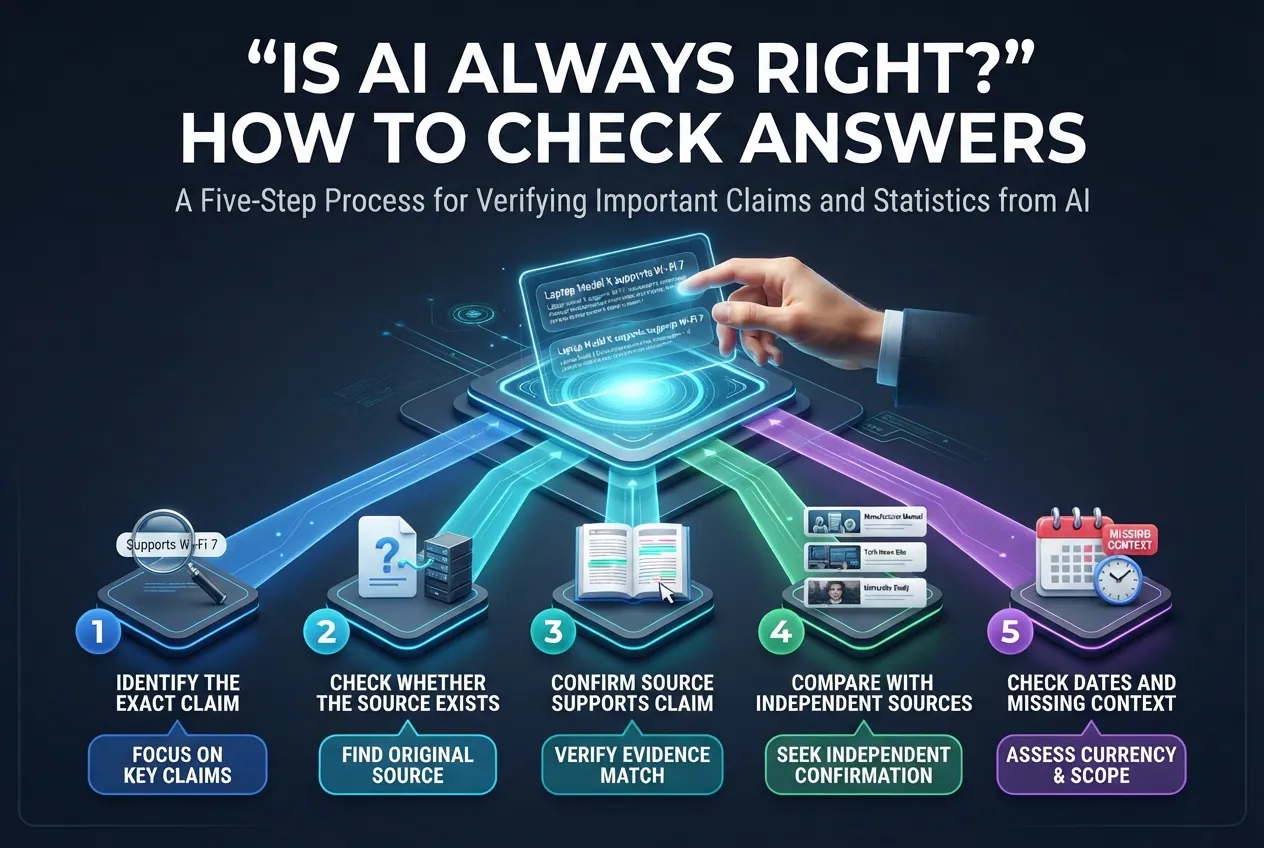
You do not need to independently investigate every sentence in every AI response. Instead, focus your effort on important claims, unfamiliar facts, exact statistics, and information that could affect a decision.
Use this five-step process.
Step 1: Identify the Exact Claim
Start by separating the main factual claim from the rest of the answer.
Suppose an AI assistant tells you that a particular laptop supports a specific version of Wi-Fi. The question to verify is whether your exact laptop model supports that version, not whether the entire explanation sounds reasonable.
For a more complex answer, identify the individual claims that matter most. Check dates, amounts, technical specifications, and recommendations separately when necessary.
This makes verification more focused and helps you catch errors that a general review might miss.
Step 2: Check Whether the Source Exists
If the AI provides a citation, search for the original source.
Check its title, author, publication date, and publisher. For a research paper, look for the actual journal page or a recognized academic database. For a technology product, start with the official manufacturer’s documentation.
If you cannot locate the cited source, do not treat the citation as evidence.
An answer can contain a mixture of real and invented details, so do not assume that a reference is genuine simply because its title looks familiar.
Step 3: Confirm That the Source Supports the Claim
Finding a real webpage is only part of the process.
Open it and read the relevant section. Does it actually say what the AI claims it says? Does the source discuss the exact product, model, date, or situation in your question?
For example, a manufacturer’s page might confirm that one laptop model supports a feature. That does not prove that every laptop in the same product family supports it.
The same principle applies to research papers. A study may report an association rather than prove that one factor caused another.
A valid source can still be used incorrectly. Always compare the original evidence with the specific statement you want to verify.
Step 4: Compare Important Claims With Independent Sources
For consequential facts, look for confirmation from at least two reputable sources when possible.
The Penn State University Libraries guide to evaluating AI output recommends checking facts and statistics against reputable sources and verifying that cited material actually supports the claim.
The most useful sources depend on the topic:
| Type of information | Useful sources to check |
| Product specifications | Official manufacturer pages and manuals |
| Software features | Official help centers, documentation, and release notes |
| Scientific claims | Original research papers and reputable scientific institutions |
| Medical information | Government health agencies, recognized medical organizations, and qualified healthcare professionals |
| Laws and regulations | Official government websites and current legal materials |
| Prices and subscriptions | Official pricing pages and authorized retailers |
Independent confirmation is more valuable when the sources are genuinely separate and credible. Several websites repeating the same unsupported claim do not necessarily provide several independent confirmations.
Step 5: Check Dates and Missing Context
Information can be accurate in one situation and wrong in another.
Before relying on an answer, check whether the information is current and whether it applies to your circumstances.
For example, a software guide published several years ago might describe an interface that has changed. A price comparison might exclude a subscription or installation fee. A legal explanation might refer to a different jurisdiction.
Ask follow-up questions when the answer appears incomplete:
- What source supports this claim?
- Is this information current?
- Does this apply to my exact model or situation?
- What important limitations should I know about?
- Which parts of this answer are uncertain or disputed?
These questions can help reveal missing context. However, asking an AI to check itself is not independent verification. You should still examine outside evidence.
Can You Trust AI for Medical, Legal, or Financial Information?
AI can help explain unfamiliar terms, summarize publicly available information, organize questions, and prepare you for a conversation with a professional. However, important health, legal, and financial decisions require additional care.
Medical Information
An AI assistant can explain common medical terms or help organize questions for a doctor. It cannot reliably diagnose every condition from a short description of symptoms.
Similar symptoms can have different causes, and important details may be missing from a conversation. A confident response may overlook an urgent warning sign or suggest an explanation that does not fit your situation.
Use reputable medical sources to check general information, and consult a qualified healthcare professional for diagnosis, treatment decisions, or concerns about serious symptoms.
The medical research discussed earlier shows why it is important to distinguish a study’s measured diagnostic performance from reliable guidance for an individual patient.
Legal Information
AI can help explain legal terms or organize questions before you seek advice. But legal answers may depend on your location, the wording of a contract, current regulations, deadlines, and the facts of your case.
An explanation that applies in one state or country may not apply elsewhere. Laws and procedures can also change.
Check current official legal sources for general rules. For a consequential dispute, contract, or legal deadline, seek advice from a qualified legal professional in the relevant jurisdiction.
Financial Information
AI can explain financial concepts, compare options, or help you organize a budget. That does not mean every calculation, tax explanation, investment claim, or repayment estimate is correct.
Check important numbers yourself and verify current rates, fees, tax rules, and product terms with appropriate official sources.
Before making a significant financial decision, consider your own circumstances and seek qualified advice when needed.
In all three areas, AI is best treated as a support tool rather than the final authority.
Frequently Asked Questions About AI Accuracy
1. Is AI Always 100% Correct?
No. AI systems can produce incorrect facts, misleading explanations, and fabricated citations. Accuracy varies by model, task, available information, and test conditions. Even when an AI tool performs well on a benchmark, that result does not guarantee that its next answer will be correct.
- How Often Is AI Incorrect?
There is no single verified percentage that applies to every AI system and task. Research studies measure different things, including factual accuracy, reasoning, medical diagnosis, and citation quality. To understand a reported error rate, check which model was tested, what questions were used, and how researchers defined an error.
- Is Google AI Overview Always Right?
No. Google explains in its official help guidance that AI Overviews can make mistakes. Follow the supporting links, read the original sources, and compare important claims with other reputable search results. For changing information, pay particular attention to publication dates and official updates.
- Can You Trust AI-Generated Information?
You can use AI-generated information as a starting point, but the appropriate level of trust depends on the task. General explanations and brainstorming may require less checking than medical advice, legal claims, financial calculations, or important technical instructions. Verify facts that could affect your decisions.
- How Can You Tell When AI Is Wrong?
Look for unsupported claims, invented citations, questionable statistics, outdated information, contradictions, and details that do not match reliable sources. These are warning signs, not proof that an answer is false. The strongest check is to find credible evidence and confirm that it directly supports the claim.
The Smart Way to Use AI
AI can be a useful everyday assistant, but its answers should not automatically be treated as facts.
Use it to understand unfamiliar topics, generate ideas, summarize material, and identify questions worth researching. When accuracy matters, check the source, confirm the relevant details, and look for independent evidence.
Remember one simple rule: trust the evidence, not the confidence of the answer.
That approach lets you benefit from AI without assuming it is always right.
Disclaimer
This article provides general information; AI accuracy and results vary by tool, model, task, source quality, software version, and individual needs. Device specifications, compatibility, subscriptions, budgets, and installation requirements can also vary. For medical, legal, or financial decisions, verify current authoritative information and seek qualified professional advice when appropriate.